Fruition Garden Journal
video tutorials, tried-and-true tips + our latest learnings to surround you with abundance all season long
Timing Is Everything: Fruition's Seed Starting Calendar
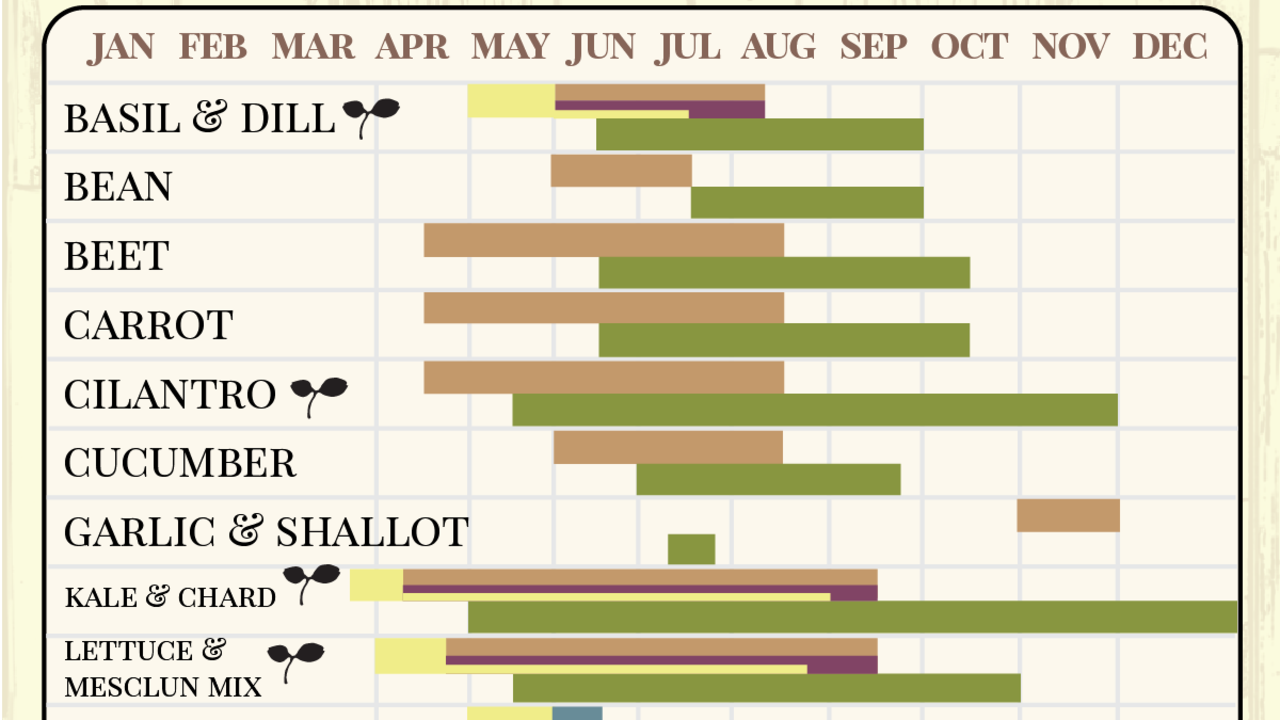
In our gardens and in our lives, timing is everything.
And Friends, it is so easy to start seeds way too early.
My dear friend Sal and I created a planting calendar for you to help nail your timing this season!
It's counter-intuitive, but plants started too early often get stressed (too little light, too few nutrients) and thus produce later and less abundantly than younger plants that are less stressed.
So hold your horses, dear Friends!
And here is our calendar for Zones 4 through 6 to keep you on track:
Each online order this season will receive one of our planting calendars, as well :)
You'll find a ton of information on this chart and each of our packets are mini-encyclopedias of information, as well. In addition to longer growing instructions, there is a quick reference tab with some pretty handy advice to have at arm's length. You'll find plant spacing after thinning, whether to direct sow or transplant (or both), days to germination, when to sow and seeding...
Ideal Varieties for Container Gardening & Raised Beds
First, a soon-to-be not-so-secret for you!
I'm in the marvelous midst of creating Fruition's first online courses, YAY!!! This post is just a fraction of what I'll be sharing to set you up for success in our Container Gardening Mini-Course. If you'd like to be first in line when our courses open in February, let me know and when they're ready I'll send you an invitation with a special thank you :)
Without further ado!
Friends, sowing well-adapted varieties makes organic gardening SO much easier.
In any size garden, on any scale farm.
Container gardens, especially.
What makes a variety well-suited for container gardening?
Two main factors:
How much space does this variety take up? Some varieties are more compact than others, making them more optimal for container gardening.
Will this variety thrive with less than optimal nutrients and less even watering? Both are realities of most container gardens, so starting with resilient seeds makes all the difference.
I...
Regionally Adapted Seed: The Secret of Great Gardening
When Heirloom Gardener asked me to write about the significance of regionally adapted seed for their Winter 2019/2019 issue, the fact that such a story is of value to a nationally-distributed magazine gave me more than a sliver of hope for the world.
As a child in New York, I thought watermelons were an absolute waste of valuable garden space. I was a whimsical child, but still practical. With long, trailing vines yielding a single fruit and sometimes none, my anticipation was almost always unrequited. Every few years we’d give them another try, only to reach the same conclusion by September: We should have sown more tomatoes, more lettuce and more beets. Less watermelon.
I could not have been more wrong.
Like our reticent red peppers, eggplants lacking abundance, late-blooming dahlias and unenthusiastic peanuts, I simply needed different seeds to have different experiences. Sowing seeds adapted to your region makes all the difference.
August Ambrosia is Fruition's...
Sneak Peek: New Varieties for 2019!
Each year we trial new varieties and develop new ones, harvesting their seeds and tucking in packets to share with you!
With each season we learn more about our seeds, ourselves, our soil, our community and our climate. Most seed companies are simply repackaging seed they've bought wholesale on the commodity market, which doesn't eliminate all the variables by any means, but it does greatly reduce their risk of not having seed in their packets.
The seeds in our packets is largely harvested on one of Fruition's four farms; we also collaborate with over a dozen talented organic seed growers to bring you the highest quality seed we can source.
And Friends, we don't always reap what we sow. Though we grew a glorious bed of Lime Queen zinnias this summer, persistent rain brought powdery mildew early to her leaves and filled her seedheads with millions of spores instead of seeds. (Thank goodness our Zinderella Peach zinnias, below, were a...
6 Easy Seeds to Direct Sow in June (& How to Transplant, If You Must)
Once final frost has come and gone and the nights are consistently above 50 F, the soil is finally warm enough for the crops that thrive in the heat of summer.
Some of them, like tomatoes and ground cherries, absolutely must be started 6 to 8 weeks prior to final frost to have any chance of surrounding you with abundance in short seasons.
Others, like basil and cosmos, will surround you with abundance whether you transplant or direct sow them.
Here, friends, are the crops whose fragile, sensitive root systems despise being transplanted. When direct-sown, they'll grow faster and fruit earlier, increasing your harvests significantly. (If you must transplant them, be sure to follow the tips on peat/cow pots and soil blocks at the bottom of the list.)
1. Cucurbits
A brush up on botanical Latin! The Cucurbit family classically sprawls and is slightly spiny, including everything from summer squash to winter squash, cantaloupe to cucumber.
As you're...
What We Just Learned About Final Frost (& Happy Memorial Day)!
Growing up in the Finger Lakes of New York, high elevation Zone 5, I have the mantra of "Memorial Day is Final Frost" deeply embedded in my brain. I am constantly questioning my assumptions about myself and the world around me; this year I was inspired to dig a little deeper into this maxim.
Are historic frost dates still relevant?
potatoes are ideally planted three weeks before final frost
Pouring over decades of temperature records in our county from the National Oceanographic & Atmospheric Association (which is totally free and fascinating, I highly recommend it!) from 1930 to present, here are my observations:
a) Our final frost dates have (surprisingly) remained fairly consistent, often occurring just before Memorial Day.
b) Even on years when final frost is weeks earlier than Memorial Day (like May 1st, 1970, which happens 2-3 times each decade), the night temps generally aren't out of the 40s consistently until around Memorial Day.
Which is all to say:
...
10 Easy Seeds to Sow in May
10 Easy Seeds to Sow in May
Daffodils bloom, wood frogs sing! As robins pull worms from the warming soil, here are ten easy seeds to sow in May.
1. Peas
The classic harbinger of spring, peas are sown as soon as your soil can be worked. (What does that mean? Check out this video.) Some years we sow peas in March. Other years, it's May. All seasons have their advantages and disadvantages. Everything's grand or everything's not grand: you choose. I digress.
Peas tolerate cool seasons better than most plants in your garden. To some extent, the earlier you plant your peas the earlier you'll harvest peas. Keep in mind: peas developing in cooler temperatures will be sweeter and more tender than those developing in the heat of summer. So tuck them in quick! And whatever you do, please resist starting them indoors; peas absolutely despise having their sensitive root systems uprooted. Most of us can relate.
To extend your pea harvest this season, sow both dwarf and full-size...
Join the Fruition Family
️⭐️ For weekly ️⭐️
️- garden tips
️- video tutorials
️- exclusive promotions
️- invitations to events
delivered right to your inbox
Because we  you!
you!
Categories
All CategoriesRecent Posts