Fruition Garden Journal
video tutorials, tried-and-true tips + our latest learnings to surround you with abundance all season long
3 Things to do with your Winter Squash Seeds
People ask me all winter long if they can save the seeds they scoop out of winter squash to sow next season.
First, the fact that people ask me this gives me such hope for the world!
Humbling yet true: I am gently discouraging you from saving your squash seeds to plant next season.
Here's what we do with our squash seeds all winter:
1. Toast and eat them, see our recipe below!
2. Make squash seed roofs on gingerbread houses.
3. Stick them on peanut-buttered pinecones for the birds.
Ironically, I really don't recommend saving your squash seeds to sow next season, unless you know a great deal about its life story.
Here's why.
Squash seeds are one of our favorite snacks. Check out our recipe inspirations below!
Why Squash Seed Usually Doesn't Grow True to Type
Many varieties are F1 Hybrids, which won't grow true to type when saved. If you've bought your squash from a grocer or even a farmer's market, chances are good it's an F1 Hybrid. So...
Why Thanksgiving Kale is My Favorite
Happy Thanksgiving, Friends!
Some years, like this year, I’ve already been skiing for a week, HOORAY! Other years, Thanksgiving arrives and leaves are bright though fading, snow yet to accumulate.
Either way, there are two things to know about how I eat kale.
First: I eat kale twelve months of the year.
Second:
I eat 98% of that kale between November and March.
Here’s why:
Sugar is nature’s antifreeze.
Literally.
This means, among other things, kale leaves are most sweet and tender in the coldest seasons. Which is SO good to know! And the reasons why are equally fascinating.
How Sugars Prevent Freezing
Across plant and animal kingdoms, sugars are formed in cells as cold approaches. These sugars protect cell walls as freezing water molecules expand. Pure water, H20, becomes jagged and sharp, cutting like sharp swords, as it freezes. With dissolved sugars, water becomes sloshy rather than sharp, maintaining the cell walls even as temperatures...
3 Keys to Maximizing Your Leaves This Fall
'Tis the season when leaves are falling and streets are lined with ready-made mulch, compost-to-be, nutrient dense and often already bagged for the intrepid gardener to stock up one of the quickest ways to build top-notch soil.
So true!
Here are three keys to maximizing your leaves this fall, to build your soil quickly and mulch most effectively:
1. Deciduous Leaves are the Best for Mulch and Building Soil
Only apply deciduous leaves as mulch in your garden beds. Coniferous pine needles will decompose and acidify your soil, often making the resulting pH less than ideal for growing vegetables, flowers and herbs. If you’re growing blueberries, rhododendrons or want blue hydrangeas, coniferous materials are one of the easiest ways to both mulch and feed them.
2. Chipping/Shredding Your Leaves has the Greatest Impact
Whether you’re building your soil with leaves or spreading them as mulch, send your leaves through a chipper/shredder first. I’ve learned the hard...
8 Easy Steps to Lifting & Storing Dahlia Tubers
Everyone loves dahlias.
Who loves to dig them?
And I agree, it's not as glamorous as harvesting lush blooms as the August dew rises.
But with a little planning and a bit of experience, you'll save many times the tubers you planted, surrounding yourself with breathtaking abundance for the coming season. Plus a few extra for your best flower friends :)
Storing your own dahlia tubers is a labor of love but so, so worth it and not too challenging, with the right tips and tools.
Why Dig Dahlia Tubers?
There are many reasons and this is my favorite: You'll have so many more dahlias for next season (not totally but essentially) for free.
Tuber productivity varies between varieties, but you'll harvest 6 to 25 tubers for each tuber you plant. Not all will have full eyes allowing them to grow a stem next spring, but you'll easily harvest more than you planted, and likely a lot more. Last week, dividing our dahlias, I had 18 perfect tubers to save from one single plant....
Six Mistakes to Avoid When Planting Garlic
Garlic is one of the easiest and most rewarding crops to grow, though it's not a cakewalk. I've grown garlic here in the Finger Lakes for over nearly three decades and here are the keys to surrounding yourself with abundance.
We've recently become enamored with growing shallots as well, which are grown in exactly the same way.
When to Plant Garlic
Garlic is planted in fall, allowing the cold to divide each clove into the bulb to come. Plant between Halloween and Thanksgiving for the healthiest garlic growth. Your goal is for each clove to establish its root system while growing as little shoot as possible.
Biggest Mistake: Planting too early.
Why? Garlic establishes it's root system before sending up a green shoot. Planted too early, the green shoot can rise several inches, acting as a straw over the winter to draw water from the clove, effectively desiccating the clove and potentially killing it.
Easy Solution: Plant between Halloween and Thanksgiving.
It's...
Harvesting Peanuts
My childhood experience of growing peanuts once --- and harvesting seven peanuts --- convinced me for two decades that growing peanuts in short seasons was extravagantly futile.
Yet seeds, again and again, show me that our imagination is the limit, that regional adaptation is the language of resilience, that we can grow so much more than we think possible.
When we started Fruition Seeds, Matthew and I were gifted a small bag of 'Northern Hardy Valencia' peanuts from a family on the Upper Peninsula of Michigan who had selected them for over two decades.
Skeptical as I was, they thrived against many odds, including cold, close spacing and a family of groundhogs.
If you garden in short seasons, as we do, regional adaptation makes a difference with any seed. This is especially true crops that need more heat, like watermelon, peppers, peanuts. We are delighted to share such seeds, and such joy, with you.
Growing Peanuts
If you can grow bush beans, you can grow peanuts....
Desiccant Packets To Store Your Seeds Better
Our Favorite Desiccant Packets for You!
Last week, sharing Fruition's Secrets to Storing Seeds, I mentioned the desiccant packets we love. Lots of people asked where to find them, so we were inspired to share them with you! You'll now find desiccant packets on our website.
If you're hardy, you can still sow your spinach this season! You likely won't harvest it til spring, but it will overwinter without flinching and grow the sweetest, most tender leaves with the snowmelt.
We sow spinach in early September to harvest in fall, winter and spring. Spinach can also be sown later, before the soil freezes, for spring harvest.
As a Child
Growing up in my father's garden, we always saved the tiny silica gel desiccant packets we found in shoes, vitamins and packages of nori. We'd toss them into an old animal crackers tin that held our beloved seed collection and there they would collect for years, as the seed packets themselves came and went.
Looking back,...
How Long Do Seeds Last? Fruition's Secrets to Storing Seeds
Whether you have a handful of your family's heirloom beans or you simply wish to keep your germination rates high for next season, storing your seeds well puts your mind at ease and will surround you with abundance for years to come.
First, I made this handy infographic for you, check it out
Below, we'll get into the nitty-gritty details.
How Long Will Seeds Last?
Many seeds will maintain great germination for three years even in your kitchen cupboard, though there are exceptions. Stored well, some seeds can last centuries.
Beans, like the Chocolate Runners, are among the longest storing seeds, often sprouting after a century in ideal storage conditions.
Conditions for Optimal Seed Storage
What conditions are needed for seeds to germinate? If you want seeds to store, give them the opposite conditions. Here are the four keys to keep your germination rates high for years to come:
- Dry
- Cool
- Rodent-Proof
- Dark
Keep Seeds Dry
Reducing...
Fruition's Fresh Ginger Harvest & Tasting Party
Save the date!
~ join us for Fruition's first annual ~
Fresh Ginger Harvest & Tastings!
Saturday, October 13th
1 to 4 pm
at 7921 Hickory Bottom Road in Naples, New York
Come taste Fruition's organic ginger and turmeric, freshly dug from our gardens!
Did you know?! We can easily grow ginger here in the Northeast, even without greenhouses or high tunnels, right in our backyards.
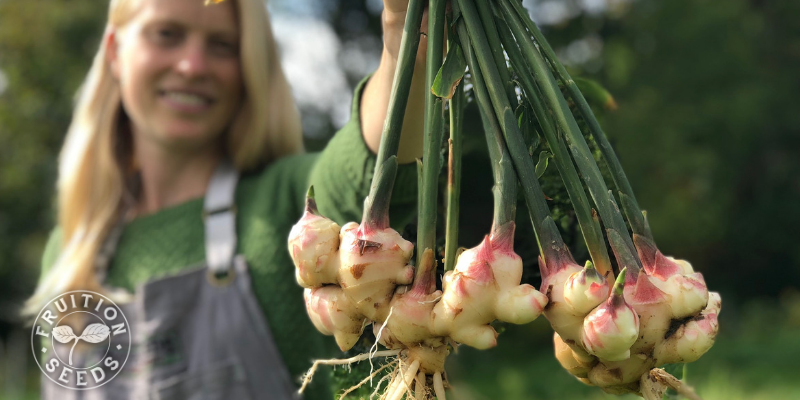
If you've never tasted fresh ginger before, it's unlike anything you've ever tasted before --- sweet and gingery, without any of the heat, melting in your mouth in a most remarkable way.
In addition to tastings, we'll have it for sale so you can stock up for winter, and stay tuned: We'll be sharing it for you to plant next season, YAY!
Throughout the afternoon, I'll be teaching how to grow your own ginger, so come with your curiosity, ask a lot of questions and know you're going to make my day :)
It's free, open to the public and we're SO excited to share the bounty of our fields with you, so...
4 Easy Ways to Harvest More This Fall
Here in the Northeast, finding easy ways to extend our season is essential to eating well as the days grow short.
After years of working on farms and experimenting at Fruition, here are the four keys of season extension:
- sowing the right seeds
- using the right tools
- at just the right time
- and harvesting in just the right way
For
free shipping
on any order of row cover + spring steel hoops, use promo code
delicious
through Tuesday, September 25th
Let's dive in.
Cold-Hardy Seeds for Season Extention
In any season, the right seeds make all the difference. September in Zone 5 is no match for seeds selected to thrive in California, where most seed is grown, which is perhaps why so many gardeners don't grow into the fall. Oh yes, and we've all been working hard all summer, so we're ready to slow down, too! But I know my own childhood-self was deterred by lettuce that wasn't up for the cause.
Now, I am so grateful to know which ones are.
'Winter...
Join the Fruition Family
️⭐️ For weekly ️⭐️
️- garden tips
️- video tutorials
️- exclusive promotions
️- invitations to events
delivered right to your inbox
Because we  you!
you!
Categories
All CategoriesRecent Posts